
Redditor Chooses Not To Attend Friend's Wedding Because His Wife Was Not Invited
"He blew up on me and accused me of always choosing others over him."

Damjan Milenkovic
- Published on

Growing up, friendships evolve and shift as people navigate different life stages. During the carefree years of adolescence, friendships are often characterized by shared experiences, laughter, and endless hours spent together.
However, as friends step into adulthood, their paths can diverge. Careers, relationships, and families—these elements of adult life can create a chasm between old friends, a space filled with unspoken words, unshared experiences, and changes that go unacknowledged.
The story of OP, a 25-year-old man, and his best friend from college offers a poignant illustration of this often painful aspect of maturing friendships. OP is facing a dilemma concerning his best friend's wedding.
Last year, he and his wife got married at a courthouse, intending to host a more celebratory event later. Now, with his friend's wedding in June and his own planned for November, a conflict arises when his friend doesn't extend the wedding invitation to OP's wife, citing space constraints at the venue.
OP originally decided not to attend the wedding, as he and his wife considered themselves a unit, always attending events together. When OP expressed his decision, his friend lashed out at him, accusing him of being uncaring and codependent.
Under pressure and feeling guilty, OP, after consulting his wife, decided to attend the wedding alone. However, OP is now contemplating reneging on his agreement to attend, feeling that his friend should understand his decision, as they both had to deal with guest limitations for their weddings.
OP asks:

OP is facing a dilemma concerning his best friend's wedding.

His friend's wedding in June and his own planned for November, a conflict arises when his friend doesn't extend the wedding invitation to OP's wife.

The Psychology of Exclusion
Dr. Megan Smith, a social psychologist, notes that feelings of exclusion can significantly impact emotional well-being.
Research shows that social exclusion can provoke feelings of anger and sadness, leading to conflict in relationships.
According to a study in the Journal of Social and Personal Relationships, perceived exclusion can trigger defensive reactions, which complicate interpersonal dynamics.
Exploring Friendship Dynamics
Choosing not to attend a friend's wedding due to feelings of exclusion can reveal deep-rooted friendship dynamics. Dr. Ian Roberts, a social psychologist, notes that such situations often reflect underlying issues of attachment and loyalty within friendships. Research indicates that perceived unfairness in social relationships can lead to feelings of resentment and withdrawal.
The decision to prioritize one's spouse over a friend may also highlight the evolving nature of adult relationships, where loyalties shift as life circumstances change.
OP originally decided not to attend the wedding.

Another layer to the issue is the contrast in their lifestyles.

OP posted an edit:

The situation surrounding the wedding invitation illustrates how feelings of exclusion can lead to misunderstandings and conflict.
Psychologists suggest that when individuals feel neglected, they often respond with anger or frustration, which can cloud judgment and lead to further issues.
Understanding these emotional responses can help individuals navigate complex social situations with greater empathy.
Conflict in friendships often arises from unmet expectations. According to a study in the Journal of Social and Personal Relationships, individuals who feel excluded from significant social events may experience feelings of hurt and betrayal. This emotional reaction can lead to a reevaluation of the friendship and its importance, prompting individuals to either confront the issue or withdraw.
Addressing these feelings openly with friends can help clarify misunderstandings and potentially strengthen the relationship.
Another layer to the issue is the contrast in their lifestyles: OP is a responsible government controls engineer deeply invested in a time-consuming project, a husband, and a father of two, while his friend still enjoys a bachelor lifestyle.
OP admits that he doesn't interact as much as he used to with his friend, which may contribute to his friend feeling neglected.
He is now questioning whether he was wrong for initially refusing to attend the wedding without his wife and is considering withdrawing his later agreement to attend solo.
OP has offered the following explanation for why they think they might be the a-hole:

All actions come with consequences.

The deadline is the deadline.

Navigating Relationship Conflicts
When faced with exclusion, it's crucial to engage in open communication to express feelings and resolve misunderstandings. Experts recommend using non-confrontational language to discuss feelings of hurt or exclusion.
Research indicates that individuals who practice open dialogue report higher relationship satisfaction and improved conflict resolution skills.
Implementing 'I' statements can facilitate honest discussions while minimizing blame and promoting understanding.
The Importance of Communication in Friendships
Effective communication is critical in navigating complex emotions related to friendship dynamics. Dr. Sarah Thompson, a conflict resolution expert, emphasizes that honest dialogue about feelings can prevent misunderstandings and foster deeper connections. Research consistently shows that friendships built on transparency and openness are more resilient and satisfying.
In this context, discussing feelings of exclusion with the friend can lead to greater understanding and possibly an apology or reconciliation, helping to repair and strengthen the friendship.
"People are free to invite whomever they want to their weddings, but..."

This Redditor can relate:

This “friendship” has expired.

Additionally, developing resilience through self-reflection can help individuals process feelings of exclusion more effectively.
Psychologists recommend mindfulness practices to foster emotional regulation and self-awareness, which can aid individuals in responding thoughtfully rather than reactively.
Building these skills can enhance interpersonal interactions and promote healthier relationships over time.
It can also be beneficial to explore one's emotions regarding loyalty and commitment in friendships. According to Dr. Alexandra Solomon, a relationship therapist, "Reflecting on our feelings about loyalty can deepen our understanding of ourselves and enhance our connections with others." Engaging in this self-reflection can provide clarity and guide future interactions. Ultimately, recognizing the evolving nature of friendships can help individuals navigate complex emotional landscapes and foster healthier relationships.
They have obviously grown apart.

Why did OP wait until the very last second to say anything?

Different people have different priorities.

Throwing judgmental terms makes OP the a-hole.

Others agree:

OP already knew he wouldn't go without his wife.

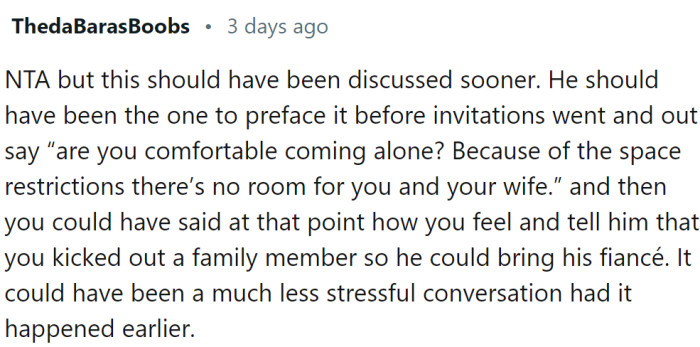
This Redditor is right:

Things should've been discussed earlier.
OP is being passive-aggressive.

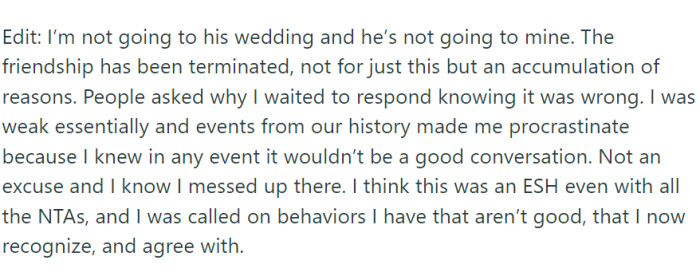
OP posted a final update, and the friendship is now terminated.
Expert Opinion
This situation illustrates the emotional challenges that can arise from perceived exclusion in friendships. It's crucial to address these feelings openly to prevent misunderstandings and foster stronger connections. Engaging in honest dialogue can pave the way for healing and deeper understanding.
Analysis & Alternative Approaches
The dynamics of friendships are complex and often influenced by feelings of loyalty and exclusion. Open communication about these emotions can significantly enhance the quality and resilience of friendships, leading to more satisfying social connections.
Expert Opinion
This scenario illustrates how feelings of exclusion can provoke strong emotional responses, often leading to misunderstandings in relationships.
It's important to address these feelings constructively to prevent further conflict and promote healing.
Analysis & Alternative Approaches
Experts highlight that understanding the psychological impact of exclusion is essential for healthy relationships. According to Dr. Esther Perel, a renowned couples therapist, "Exclusion can create deep emotional wounds that affect our ability to connect with others." Fostering open communication can mitigate feelings of exclusion and enhance relational satisfaction, as emphasized by Dr. Susan David, an expert in emotional agility, who states, "When we acknowledge and express our feelings, we pave the way for deeper connections." Ultimately, prioritizing empathy and understanding can lead to more harmonious interpersonal dynamics.